**UPDATE: NPR did a story on Paraguay. Here is the link.
I am an Agricultural Extension Peace Corps Volunteer serving in Paraguay.
Wednesday, June 27, 2012
So What’s Going on Down There?
**UPDATE: NPR did a story on Paraguay. Here is the link.
Saturday, June 9, 2012
Shock: Culture, Food, and the Potential International Appeal of Tereré
![]() |
| In Ann Arbor, on an industrially awesome swing. |
- Instigram
- Siri
- Indiana's political mess, locally and statewide
- Occupy as explained to me by participants (not just news sites)
- Groupon (still unclear on this one)
- Dubstep
- Flexing
- The sad state of Wisconsin
![]() |
| In Bloomington, on my way to Contra Dance. |
![]() |
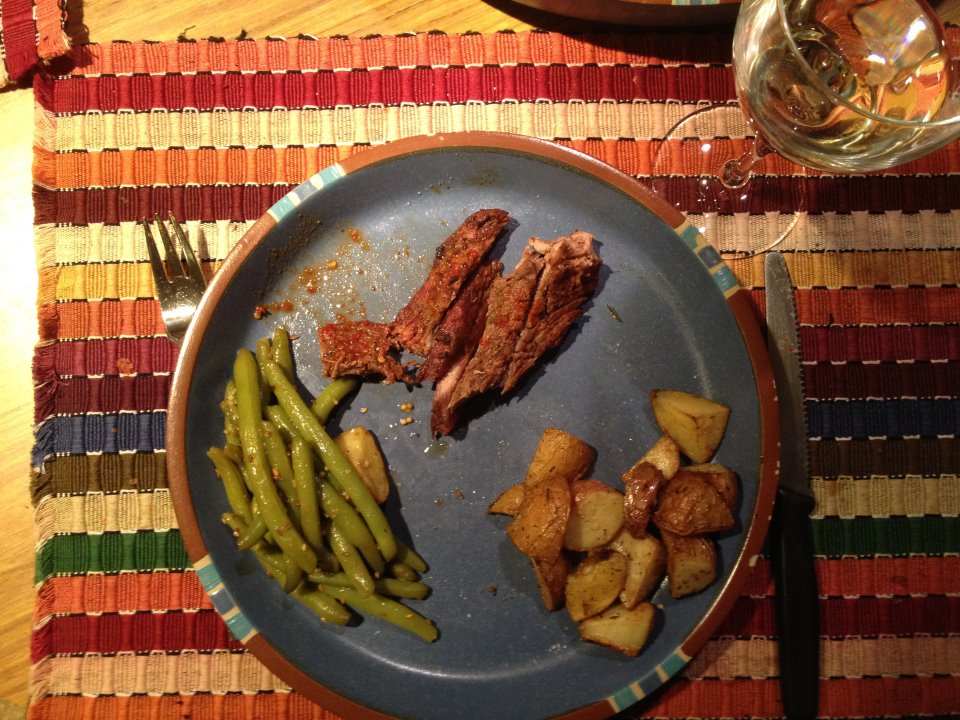
| Flank steak with my Dad's homemade hot sause, local green beans with spicy mustered sause, and local new potatoes. Yum. |
Wednesday, May 16, 2012
Bigots Deserve Access to Development Workers Too
| Ña Annastasia showing the abonos verde carnavalia intercropped with mandioca (This photo is completely unrelated to this blog post... but I like it anyways). |
Saturday, May 5, 2012
Pets: The Life and Death of Campo Mascotas.
| Clearly Perejil enjoys the space heater as much as I do. |
| My new dog! Se llama Pepper. |
Wednesday, April 25, 2012
Fiesta Patronal, Semana Santa and Chipa
| Fiesta Patronal |
| I included this photo because of the grain plants on the priest's stole. Super appropriate for such an agricultural society. |
| The women of the community cooking lots of food for everyone. They were really flattered that I wanted to photograph them while they worked. Cooking is something they take pride in, but it is not very frequently acknowledged. |
| So much food! |
![]() |
| Na Oheniea and some of her grand children. |
| We made the traditional food for Semana Santa: chipa. |
![]() |
| Look! My name in chipa! |
| This is a tatakua. Basically a brick oven especially for Paraguayan specialties... like chipa. |
| Baking the chipa. |
| More chipa... |
| On the Thursday of Semana Santa (the biggest meal of the week), I ate dinner with my favorit host family. |
| A modest but delicious spread of bbq chicken, sopa paraguaya (not actually a soup), mandioca (yucca) and soda. After lunch we snacked on... you guessed it: chipa. |
Monday, March 26, 2012
Dont Look Too Closely or The Story of the Horse Spider
Wednesday, March 14, 2012
Solitude, Cotton, and Luffas

Solitude and Judgment.
It has taken me several weeks to decide to post this update, mostly because it is rather pessimistic in tone (its not completely negative so keep reading to the end!). Its suggested in training, that we limit our most negative thoughts to our journals and not blog or write letters home about it. Still I felt it was important to express some of my frustrations, disappointments and worries here, because those, along with the good things, are part of the Peace Corps experience too. Frequently when people talk about the Peace Corps they give you a cursory warning, along the lines of the famous “the hardest job you’ll ever love” line. But there are some significant changes that can happen to people, especially when they are strong enough, healthy enough, and busy enough to stay in site for long stretches of time. For example, I feel myself becoming a more solitary, pensive person. I spend a lot of my time at site sitting and listening to other people while I struggle to communicate an idea, plan or joke. I DO talk to people, but I also spend a lot of time just hearing words fall over me as I try and peace together the meaning. Additionally I spend my nights and siestas alone. I am at once lonely, and intensely grateful to finally have some privacy.
Recently, when I’m in Asuncion and have gotten to hanging out with volunteers, I find myself speaking less and less. I hear their words wash over me too. I understand the words, but I don’t necessarily participate or sympathize. I don’t know what this means. Does it mean I feel like I can relate to them less? If that’s the case, what the crap is going to happen when I am back in the states? Will I still be able to relate to people and their “problems?” Already I get almost angrily condescending when I read facebook posts about a new sale at Target, or frustration at Red Lobster for raising their prices. “Who cares? Are these seriously the biggest concerns in your life?” I think. Then again, most of MY updates are about the Paraguayan drought, and honestly, I know most facebook friends couldn’t care less.
I feel similar resentment/anger at the small number of volunteers who appear to be doing nothing with their time here, and don’t care about the fact that they are doing nothing. Plenty of volunteers feel unproductive. But the vast majority of them worry about this, try to do better and end up doing great work in their communities. But a few people, not many, but a few, seem like they are just here for a goldstar on their resume.
Art and Cotton.
A few weeks ago I hosted a very successful art camp with Maddy, another volunteer. It was a chance for kids in the community to exercise their creativity, something that doesn’t happen very often in a school system based on rout memorization and an artistic tradition of imitation (I tried to find a link that discussed the history of Guarani artists in the Jesuit Missions, but had no luck). I plan on having an art day once a month during the school year, which started up again in the last week of February. I had had several kids who promised they would come to the art camp not show up. I initially was frustrated, but latter discovered that they were unable to come because they had been picking cotton all day in the 100 degree heat. In fact, even though the school year has started, not many students are the schools currently due to the cotton harvest. In agricultural communities, kids are always going to be doing some sort of farm work. That’s not necessarily a bad thing. The problem arises when children’s educational opportunities are limited due to their need to work. Working on a family farm is one thing, working on the community’s patron’s field for money is another.
An Amusing Story About Long Green Vegetables.
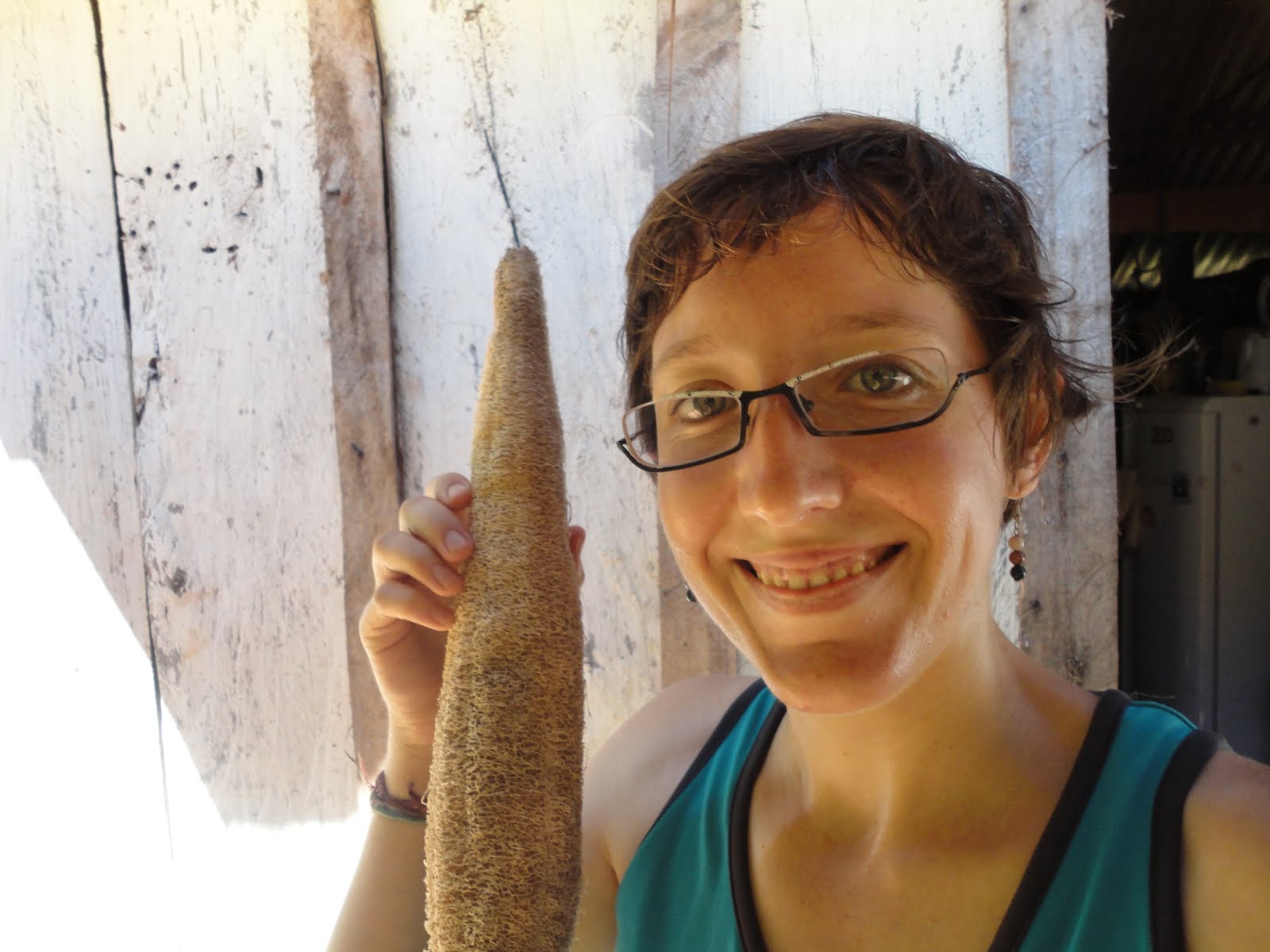
Several months ago, I planted zucchini, cucumber, and luffa plants all around the same time. I then promptly forgot where I planted each vegetable. Eventually I had several vines climbing around my garden with large, heavy green fruit. I ate one, and it was a delicious, delicious cucumber. That particular vine died, but I thought nothing of it, seeing as how all the other vines were taking over my garden and I was clearly soon going to have cucumbers coming out of my ears. Shortly thereafter I picked another long, heavy green fruit. It tasted AWFUL. Clearly not a cucumber. Undeterred, I try another one, only this time sautéing it in butter and salt, that makes anything taste good, right? Wrong. It was still AWFUL. Clearly not a zucchini. Frustrated and confused, I asked a Paraguayan friend who came to visit me, why my cucumbers and zucchini were so nasty. He looked at me and said “those are esponja vegetal (luffa) plants… Your not supposed to eat them.” So this afternoon, after several months of waiting, I finally had my first shower using a sponge I grew myself! Guess what all my Peace Corps friends are going to be getting for their birthdays? After all, how many sponges can one person really use? After my shower I had a nice cool glass of lemonade squeezed from the lemons on the tree in my front yard. Que tranquillo. Despite the frustrations and worries I have with Peace Corps and myself, overall things are pretty great.
Saturday, February 18, 2012
Everything is Falling Into Place
This is an I’m-so-freaking-happy-in-my-community blog entry.
I have been having these days recently, where I just feel pleased and hopeful about my role here (its not perfect, see end of post). It’s great to feel that way, and so I thought I should write a little blog post about it. After a year and 2 month in site, here is what’s going on.
Language
My language has gotten to the point where I can really talk to people, and joke, and be fairly honest about my thoughts and feelings on topics. Not only has my Spanish improved dramatically (still hopeless at Guaraní, but that deserves a whole other, not nearly as uplifting, blog post), but the families I work with the most, know the idiosyncrasies of my language patterns, and therefor usually understand me when I’m butchering my way through an explanation. I have also attuned well enough to what is culturally appropriate to talk about, and what conversations I might need to steer clear of. Although, perhaps I am overly cautious when it comes to topics of sexuality.
Integration
I have been here long enough that I am not longer real exciting. I still have my strange extranjera ways, but people have gotten used to them by now. People still see and comment on everything I do, everywhere I go, and everything I buy or throwaway, but to a certain extent they do that to their neighbors too. Plus, now I also stare back at people. Finally, I have gotten to the point in my integration and language ability, that when I feel lonely or sad I don’t have to hid in my house (although sometimes I do), I can go find a neighbor I feel close to and talk and relax for awhile. It doesn’t feel like work, it feels like friendship.
Work
While I’m still not doing as much “work” in my community as I would like to be doing, several things are beginning to gain momentum. Most people are interested in my advice on small things. Most of the work I manage to do is one-on-one, rather than large charlas (meeting/lecture). My summer English class is going well, mainly because the only students who bother to show up are the ones who REALLY want to learn. I built two more fogons (fuel efficient cook stoves) recently. I had helped build seven of them back in August with some high schoolers who came to my community for a month via the organization Amigos de las Americas.
But this time around it was just a Peace Corps project. I built one this past month with the family it was intended for, and my friend Nate (fellow volunteer and fogone building extraordinaire). The second fogone, just me and the family built.
I was worried about how this would go, but it ended up being a wonderful time. One of the girls in the family used to be my host sister so we are already pretty close. At first she watched and helped out in peripheral ways, like serving terere, and refilling the mescala (red dirt and cement) buckets. Next she started handing me bricks, and by the time we got to the chimney, she started laying the bricks down herself. She had seen her brother, father and I laying bricks the day before, and finally she wanted to try and do it herself. Bricklaying is definitely outside of normal gender roles for girls, so this felt like a victory of sorts. There needs to be more options for work if girl in the campo doesn’t want to exclusively do domestic labor all day. She was good at the job too. I, and other volunteers, are constantly doing things outside of our expected gender roles (males-cooking their own meals, cleaning their own clothes, females-bricklaying). It was interesting see the influences of those actions first hand.
It’s not always sunny in Punta Suerte (actually with the drought its always freaking sunny, damn it).
Clearly I am happy in site. When people ask me (and the do… all the time) “Are you happy in Paraguay?” I can honestly answer yes. But sometimes its hard to be here. Sometimes I feel cut off from life in the states. Life and friends and family are passing me by while I’m stuck in Paraguay talking about how hot it is for the hundredth time this week. I’m tired of constantly having minor health problems that leave me feeling run down. I am tired of the planning involved in timing my trips to Santani well enough to insure that I have enough food (especially now that its summer and so my garden is almost completely dead. Its possible to do summer gardens but the drought has made it very difficult). I’m tired of the heat… my god, the heat. In addition to the drought, San Pedro has also had an outbreak of food-and-mouth disease... a double whammy of sorts. I’m sick of the damn frogs taking over my house and pooping everywhere (I trapped about 20 in a bag, but couldn’t bring myself commit frog genocide as suggested by my neighbor, so I walked down the road and released them). I miss the ease, convenience and comfort of life in the States.
But I’m so glad I’m here. There is nothing else I would rather be doing with my life right now. I only hope I’m able to give to my community a fraction of what its given me.