Wednesday, March 14, 2012

Solitude, Cotton, and Luffas

Clearly I am the best source of entertainment for miles around. I miss privacy.

Solitude and Judgment.

It has taken me several weeks to decide to post this update, mostly because it is rather pessimistic in tone (its not completely negative so keep reading to the end!). Its suggested in training, that we limit our most negative thoughts to our journals and not blog or write letters home about it. Still I felt it was important to express some of my frustrations, disappointments and worries here, because those, along with the good things, are part of the Peace Corps experience too. Frequently when people talk about the Peace Corps they give you a cursory warning, along the lines of the famous “the hardest job you’ll ever love” line. But there are some significant changes that can happen to people, especially when they are strong enough, healthy enough, and busy enough to stay in site for long stretches of time. For example, I feel myself becoming a more solitary, pensive person. I spend a lot of my time at site sitting and listening to other people while I struggle to communicate an idea, plan or joke. I DO talk to people, but I also spend a lot of time just hearing words fall over me as I try and peace together the meaning. Additionally I spend my nights and siestas alone. I am at once lonely, and intensely grateful to finally have some privacy.

Recently, when I’m in Asuncion and have gotten to hanging out with volunteers, I find myself speaking less and less. I hear their words wash over me too. I understand the words, but I don’t necessarily participate or sympathize. I don’t know what this means. Does it mean I feel like I can relate to them less? If that’s the case, what the crap is going to happen when I am back in the states? Will I still be able to relate to people and their “problems?” Already I get almost angrily condescending when I read facebook posts about a new sale at Target, or frustration at Red Lobster for raising their prices. “Who cares? Are these seriously the biggest concerns in your life?” I think. Then again, most of MY updates are about the Paraguayan drought, and honestly, I know most facebook friends couldn’t care less.

I feel similar resentment/anger at the small number of volunteers who appear to be doing nothing with their time here, and don’t care about the fact that they are doing nothing. Plenty of volunteers feel unproductive. But the vast majority of them worry about this, try to do better and end up doing great work in their communities. But a few people, not many, but a few, seem like they are just here for a goldstar on their resume.

Art and Cotton.

A few weeks ago I hosted a very successful art camp with Maddy, another volunteer. It was a chance for kids in the community to exercise their creativity, something that doesn’t happen very often in a school system based on rout memorization and an artistic tradition of imitation (I tried to find a link that discussed the history of Guarani artists in the Jesuit Missions, but had no luck). I plan on having an art day once a month during the school year, which started up again in the last week of February. I had had several kids who promised they would come to the art camp not show up. I initially was frustrated, but latter discovered that they were unable to come because they had been picking cotton all day in the 100 degree heat. In fact, even though the school year has started, not many students are the schools currently due to the cotton harvest. In agricultural communities, kids are always going to be doing some sort of farm work. That’s not necessarily a bad thing. The problem arises when children’s educational opportunities are limited due to their need to work. Working on a family farm is one thing, working on the community’s patron’s field for money is another.

The moster masks from art camp.

My friend and fellow PCV Maddy reading to the kids at camp.

An Amusing Story About Long Green Vegetables.

Several months ago, I planted zucchini, cucumber, and luffa plants all around the same time. I then promptly forgot where I planted each vegetable. Eventually I had several vines climbing around my garden with large, heavy green fruit. I ate one, and it was a delicious, delicious cucumber. That particular vine died, but I thought nothing of it, seeing as how all the other vines were taking over my garden and I was clearly soon going to have cucumbers coming out of my ears. Shortly thereafter I picked another long, heavy green fruit. It tasted AWFUL. Clearly not a cucumber. Undeterred, I try another one, only this time sautéing it in butter and salt, that makes anything taste good, right? Wrong. It was still AWFUL. Clearly not a zucchini. Frustrated and confused, I asked a Paraguayan friend who came to visit me, why my cucumbers and zucchini were so nasty. He looked at me and said “those are esponja vegetal (luffa) plants… Your not supposed to eat them.” So this afternoon, after several months of waiting, I finally had my first shower using a sponge I grew myself! Guess what all my Peace Corps friends are going to be getting for their birthdays? After all, how many sponges can one person really use? After my shower I had a nice cool glass of lemonade squeezed from the lemons on the tree in my front yard. Que tranquillo. Despite the frustrations and worries I have with Peace Corps and myself, overall things are pretty great.
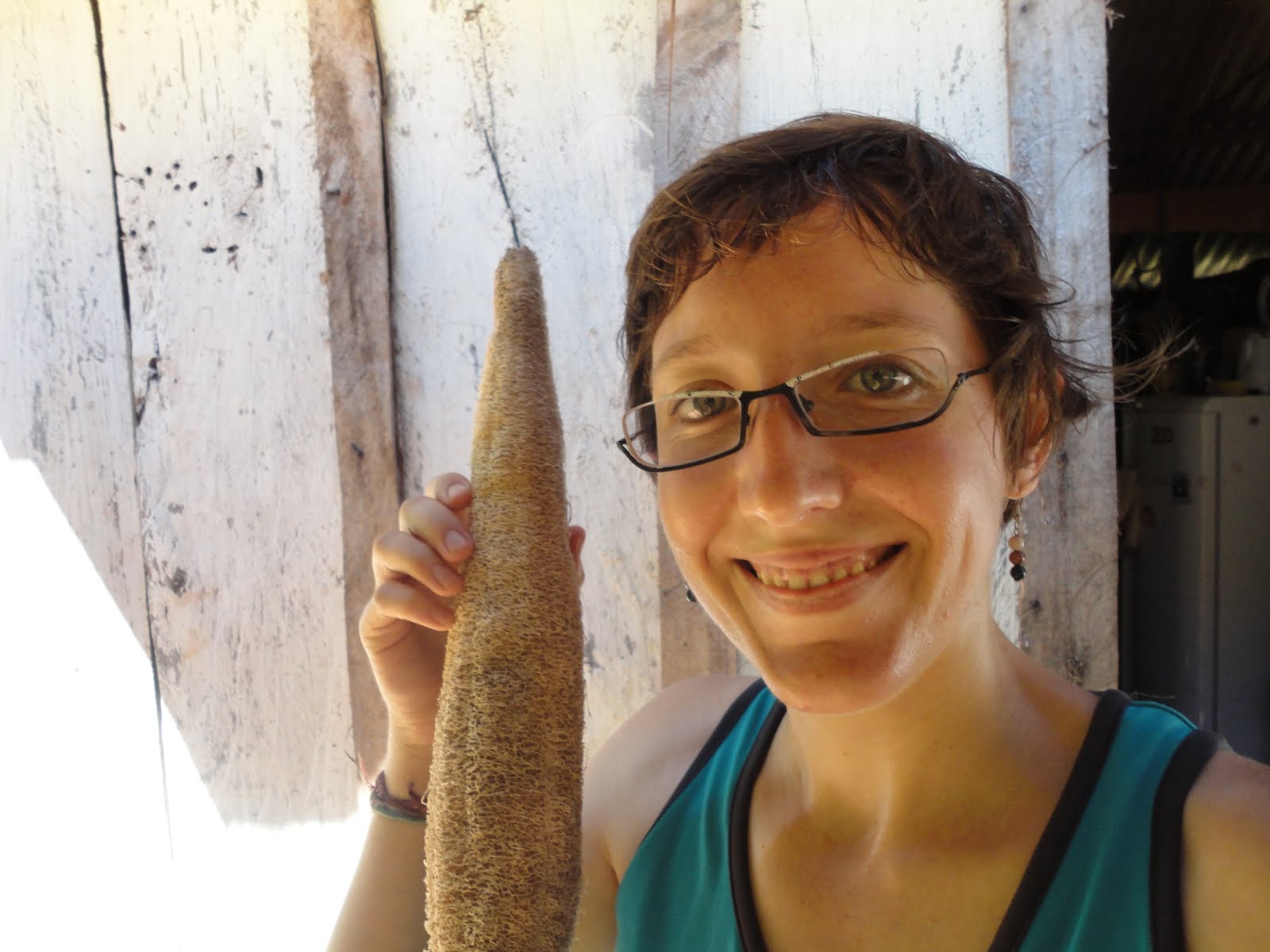

My first successful luffa harvest, pictured after the skin has been peeled away... clearly NOT a cucumber.

Saturday, February 18, 2012

Everything is Falling Into Place

This is an I’m-so-freaking-happy-in-my-community blog entry.

I have been having these days recently, where I just feel pleased and hopeful about my role here (its not perfect, see end of post). It’s great to feel that way, and so I thought I should write a little blog post about it. After a year and 2 month in site, here is what’s going on.

Language

My language has gotten to the point where I can really talk to people, and joke, and be fairly honest about my thoughts and feelings on topics. Not only has my Spanish improved dramatically (still hopeless at Guaraní, but that deserves a whole other, not nearly as uplifting, blog post), but the families I work with the most, know the idiosyncrasies of my language patterns, and therefor usually understand me when I’m butchering my way through an explanation. I have also attuned well enough to what is culturally appropriate to talk about, and what conversations I might need to steer clear of. Although, perhaps I am overly cautious when it comes to topics of sexuality.

Integration

I have been here long enough that I am not longer real exciting. I still have my strange extranjera ways, but people have gotten used to them by now. People still see and comment on everything I do, everywhere I go, and everything I buy or throwaway, but to a certain extent they do that to their neighbors too. Plus, now I also stare back at people. Finally, I have gotten to the point in my integration and language ability, that when I feel lonely or sad I don’t have to hid in my house (although sometimes I do), I can go find a neighbor I feel close to and talk and relax for awhile. It doesn’t feel like work, it feels like friendship.

Work

While I’m still not doing as much “work” in my community as I would like to be doing, several things are beginning to gain momentum. Most people are interested in my advice on small things. Most of the work I manage to do is one-on-one, rather than large charlas (meeting/lecture). My summer English class is going well, mainly because the only students who bother to show up are the ones who REALLY want to learn. I built two more fogons (fuel efficient cook stoves) recently. I had helped build seven of them back in August with some high schoolers who came to my community for a month via the organization Amigos de las Americas.

But this time around it was just a Peace Corps project. I built one this past month with the family it was intended for, and my friend Nate (fellow volunteer and fogone building extraordinaire). The second fogone, just me and the family built.

I was worried about how this would go, but it ended up being a wonderful time. One of the girls in the family used to be my host sister so we are already pretty close. At first she watched and helped out in peripheral ways, like serving terere, and refilling the mescala (red dirt and cement) buckets. Next she started handing me bricks, and by the time we got to the chimney, she started laying the bricks down herself. She had seen her brother, father and I laying bricks the day before, and finally she wanted to try and do it herself. Bricklaying is definitely outside of normal gender roles for girls, so this felt like a victory of sorts. There needs to be more options for work if girl in the campo doesn’t want to exclusively do domestic labor all day. She was good at the job too. I, and other volunteers, are constantly doing things outside of our expected gender roles (males-cooking their own meals, cleaning their own clothes, females-bricklaying). It was interesting see the influences of those actions first hand.

It’s not always sunny in Punta Suerte (actually with the drought its always freaking sunny, damn it).

Clearly I am happy in site. When people ask me (and the do… all the time) “Are you happy in Paraguay?” I can honestly answer yes. But sometimes its hard to be here. Sometimes I feel cut off from life in the states. Life and friends and family are passing me by while I’m stuck in Paraguay talking about how hot it is for the hundredth time this week. I’m tired of constantly having minor health problems that leave me feeling run down. I am tired of the planning involved in timing my trips to Santani well enough to insure that I have enough food (especially now that its summer and so my garden is almost completely dead. Its possible to do summer gardens but the drought has made it very difficult). I’m tired of the heat… my god, the heat. In addition to the drought, San Pedro has also had an outbreak of food-and-mouth disease... a double whammy of sorts. I’m sick of the damn frogs taking over my house and pooping everywhere (I trapped about 20 in a bag, but couldn’t bring myself commit frog genocide as suggested by my neighbor, so I walked down the road and released them). I miss the ease, convenience and comfort of life in the States.

But I’m so glad I’m here. There is nothing else I would rather be doing with my life right now. I only hope I’m able to give to my community a fraction of what its given me.

Sunday, February 5, 2012

Challenges and Identity


Im guessing most people who read my blog (if in fact anyone does *wink*), have already read this. For those who haven't, its an article I wrote about the challenges of being an lgbt Peace Corps volunteer in rural Paraguay. I was hesitant to put the link on my blog incase it became some sort of security issue, however I think that is incredibly unlikely. Plus, as I explain in my little essay, the stress of being closeted at site is enough. I dont want to censer and second guess my self in other facets of my life as well.  Plus I want other queer Peace Corps volunteers or future volunteers to have an idea of what their life might be like.  The reality is, there is very little information out there.
Ironically, having to be closeted in my day to day life has made my sexuality a more central part of my identity that it ever was before. The very need to hide who I am has made me relies how important that part of me is.
I have lots more to say on this, but for now Ill just leave you with the link to the article, and adorable photos from the pre-school graduation. The kids were dancing in boy-girl pairs, and then they were told to change partners... so most of them went to their best friends, resulting in same-sex pairs. Adorable.


Wednesday, February 1, 2012

Thermos Assumptions


A few weeks ago, my family left Paraguay after a three week visit. Being able to spend the holidays together was wonderful. I am happy that in the future, when I talk about Paraguay and my experience here, they will truly have an understanding of what I am saying.

Now. On to Tereré.

Thanks to my friend Teresa loaning us her tereré thermos (my Dad is holding it in the photo above), I was able to get my family quite devoted to the fantastically refreshing drink of the Paraguayan Summer. Also, thanks to the thermos, I felt super Paraguayan. This point was driven home, when a group of four American tourists spotted us with the thermos on a bus to Iguazu Falls (technically in Argentina, but right on the boarder of Paraguay and Brail), and started talking in English about it. They assumed we couldn’t understand them!

One of the women not so subtly pointed to the thermos and said “look! That’s for drinking mate.”

My mother over heard this and decided she was thirst for some tereré so we started serving ourselves. The tourists watched us serve and pass the guampa back and forth and started discussing mate.

“Do you think its tastes any good?” one girl said.

“It has drugs in it you know” another says.

“Really? Wow. What kind of drugs? I wonder how ad

dictive it is” says the first girl.

“You got to watch out for things like that” says a friend.

“I bet they are real addicted” says another.


All four turn and watch us drink away.


At this point, tired of suppressing my laughter and tired of pretending I didn’t notice them staring at us, I start talking to my mother in English while watching the tourists out of the corner of my eye.

There eyes go wide as it dawns on them that we have understood anything they have said. They look abashed and say nothing for the rest of the ride.

What was interesting about all of this, is that it was the first time (that I’m aware of) that I have been mistaken for a South American… and it was all due to the tereré thermos. To be at ease using something so iconic of the region was enough to trump my other extranjero features (skin color, Chaco sandals, hair cut). In fact they must have mistaken my whole L.L.Bean clad family for South Americans.

Granted, like any slightly caffeinated drink, it can be addictive… but honestly. They were a little quick to judge something they clearly have no knowledge of. Also, I can understand the assumption that no one will understand English in campo Paraguay; I make that assumption everyday. Infrequently a Paraguayan English teachers or a Mormon convert will prove me wrong, and will strike up a conversation. But making the assumption that no one understands English while visiting one of the biggest tourists attraction in South America is just naive.

I plan on buying my very own thermos next week.


Thursday, December 22, 2011

Out of Site: Virgencita de Caacupe, and the Swearing Out of G-31.


I spent several days out of site a few weeks ago (but only now have an internet connection strong enough to post this update). But thanks to some wonderful friends, I got the opportunity to do one of the most quintessential Paraguayan traditions. I participated in the pilgrimage to Caacupe. Its hard to describe the role the Virgencita de Caacupe plays in the Paraguayan culture. In the space of about a week, around 300,000 people go to Caacupe, cumulating on the 8th of December. The majority of pilgrims walk at least part of the way there. For the rest of the year, Caacupe has a population of only 42,000, and Paraguay itself only has a population of around 6,460,000. So having 300,000 people converge on one spot is phenomenal.

For me, the most fascinating part of the experience was the sensation of walking together with thousands of other people. It’s a fun, celebratory atmosphere. We walked from 9pm to 1am on the night of the 7th. Walking at night has the benefit of avoiding the intense summer heat, and considering we are walking up one of the largest hills in the country, that is important.

Many people come to pray for a miracle, or to give thanks for prayers answered in the past year. But many people (not just Yankees like me), come merely for the experience of participating in a longstanding, uniquely Paraguayan, cultural tradition.

This photo is from a visit to the church last year. During festival de Caacupe, it was much to crowded to get past the courtyard.

I definitely want to do it again next year, and walk maybe two or three times the distance. I’m much to lazy/out of shape to do a marathon (or any sort of running honestly), but I can walk of ages! I’m also thinking about trying to bike it. Anyone want to join me?

The day after walking to Caacupe, I went to the G-31 despideda (goodbye party). I’m G-34, so G-31 was my sister G. They means they were the agriculture and environmental education group that swore in a year before us. When we swore in they had already been here a year. Now that they have sworn out, that means…. I have been in my site for a whole year, and a new Ag and EE group (G-37) has sworn in. We are now the older, more experience G! I didn’t really feel much last year when the old group swore out just as we were swearing in. After all, I hardly knew them. But this year it has been hard saying goodbye to people I have come to respect and gotten to know well. I no longer have wise seasoned Ag volunteers to turn to when I have a question (actually I still have the talented Ag coordinator). It’s the first time that a G has sworn out, and I have really felt the loss. I miss you G-31.

Friday, December 2, 2011

Love is Sopa Paraguaya

Today was on its way to being a bad day. I stopped by a neighbors house and told him that the English class (that had been canceled last Wednesday due to a freak windstorm) was rescheduled for today at 4. I had been telling people in the community the rescheduled time sense Wednesday evening after the windstorm. Finally, this neighbor told me “you can’t have class today. Esquella San Jose is having their graduation this afternoon. No one will come to your class.”

Despite the fact that I had told several families about the class, no one had mentioned that it conflicted with this important community wide event. No one even told me the event was going to happen. I had several people say “yes. Ill be there” when clearly they wouldn’t be able to.

This happens frequently. People don’t want to disappoint or be rude by saying they can’t come (or they don’t understand a word I’m saying)… but that doesn’t mean there are going to show up. Honestly they same thing happened when I did turn-out for events in the States. However in the States I was able to culturally and linguistically interpret the responses better and fairly accurately gauge how likely someone was to turn up. In Paraguay, not only is it more difficult to interpret the responses people give me, but I’m also ignorant of important community events that could influence attendance.

Anyway, I thanked this neighbor for telling me and told him that the class was NOW rescheduled to Monday. I walked home incredibly frustrated and angry. Sometimes things just build up, and today was one of those days. No one in the community respects me. No one even bothered to invite me to the graduation. No one wants to be involved in the things I do. Why oh why is life so hard? I was emotionally over reacting to the whole thing.

Shortly thereafter, I decided go ahead and go to the graduation that was causing all the trouble.

It was great. The families were proud and the kids were excited. The children preformed traditional Paraguayan dances. Afterwards as the families split up into groups at various tables, a señora brought be a paper plate of food. Moments latter, another señora another plate…. By the end I had five or six separate plates of empanadas, sopa Paraguaya, and mellinasa.

It made me feel better about everything. My community cares about me. I’m awkward, I’m ignorant of things everyone knows about (and so no one thinks to tell me), I’m constantly doing strange things. But people are happy I’m here, and they want me to know that by giving me more sopa Paraguay than I can possibly eat.

I left the graduation with my heart (and my bag of food) overflowing.