Friday, August 31, 2012

Sustainability in Development Work

Chicken/ Gallina/ Ryguasu
I am nearing the end of my service.  After 20 months in site, I am trying to look back on what exactly I accomplished here.   I worked hard to make most of the activities I did sustainable.  After all, what use is development work unless it is sustainable?  Unsustainable development work can even be harmful to the very communities its supposed to help.  The thing is, frequently unsustainable development work has immediate tangible results that make the do-gooders feel… well, good.  You can literally see what you have done (it just might not be there 2 years- or 2 months- after you leave).

Personally, I feel like my work falls into three categories: Unsustainable, Maybe Sustainable, Sustainable. 


English class.

Unsustainable: My most unsustainable work was probably the English classes.   Clearly those classes cannot continue with out my presence.  I was hesitant to teach English for this very reason, but it was one of the few requests I heard again and again from my community; Its important to listen to what the community wants.


In the foreground, the floor cooking fire that campo families use when they don't have a fogone. In the background, a newly build fogone (it's still missing the chimney).  The benefit of a fogon is two fold: It is much more fule efficient than a fire on the ground, and it funnels the smoke out of the kitchen greatly reducing heath problems for women and children (who generally spend large chunks of their day in the kitchen).

Maybe Sustainable: The fogones (fuel-efficient cook-stoves).  Some were built with two stellar Amigos de las Americas volunteers, some were built using EPCA (it stands for Environmental... something, something, something) grants.  Most involved some family participation.  I put this in the Maybe Sustainable category, because some of the families only participated in periphery ways.  They provided the red dirt, mixed the mescala, sought out glass bottles to help fill in the base.  But in other families, members were more involved in the actual construction; laying the bricks along side the volunteers, participating in every stage of the construction.  In these families, if the stove breaks down, they will likely be able to fix it.  I won't go so far as to say that they could build one on their own from memory.  But with a good clear diagram they might.  Another maybe sustainable activity is the worm bins I have with a family.  Its too early to tell if this will last for any time at all.

Me and a community member working together.
Community members finishing up their fogone.


Sustainable: With my encouragement and guidance, 5 or 6 families planted abonos verdes last year (nitrogen fixing green manures).  This year most of the families appear to be saving the seeds and planting again without any comments or reminders on my part.  This makes me happier than I can express.  Maybe I did accomplish something here after all.  Also I worked in both school gardens last year, talking about the importance of compost and companion planting.  This year, I have done no work in the school gardens, but I can see the compost piles from the road and the plant beds look to have two or three types of vegetables in them instead of massive, unbroken beds of lettuce.
School garden, last year.

I’m not sure what my last 3 ½ months in site will bring (or if I’ll be in Paraguay for an extra year or not).  But as of now, I’m feeling pretty good about my service.


Friday, July 20, 2012

A Few Words About the Future

A farmer showing off his abonos verdes kumanda yvrai.

Everyone in G 34 (the group I swore-in with) recently received our official invitation to our COS (close of service) conference.  The COS conference happens 3 moths before we are scheduled to swear out.  Our conference is in the first week of September, our swear-out date is the middle of December.  Its my understanding that the COS conference is supposed to prepare us to reenter American society.  I think we get info on our healthcare options, our non-competitive status for some(?) federal jobs, and the reentry culture shock we might experience.
It’s hard to look that far ahead right now. I’m involved with my community and comfortable in Paraguayan culture.  I’m never going to figure out all aspects of Paraguayan culture (that would be imposable), but I’m at the point where I am excited to eat my favorite dishes, I don’t feel too  awkward at fiestas, and I can sit and drink terere or mate for hours talking about cualquier cosa or just sitting in comfortable silence.
My very limited internet access makes doing the research necessary for planning my future difficult.  However, I did decide to apply for the position of Peace Corps Volunteer Coordinator (PCVC) for the agriculture sector.  If I get the position, I would work in the office in Asuncion in a Volunteer support capacity/ assistant to the head of the Agriculture sector.  I hope to get the position because I would get to stay in Paraguay for an additional year, and I would continue to help support my fellow Volunteers.  Of all the activities I have done in Peace Corps, supporting my fellow Volunteers in both a formal and informal capacity, as been one of the most rewarding (and challenging) parts.  Don’t get me wrong, I feel incredibly fulfilled when I one of the farmers I work with finally harvests the abonos verdes I educated him on months before, but I feel like the Volunteer support activities actually speaks to a career path I might follow post Peace Corps.
If I don’t get the coordinator position (a very real possibility) I am thinking about how else I can potentially follow this new found calling.  How can I translate these activities into a career in the US (or abroad for that matter).  I like supporting people in a new and stressful environment, and helping them navigate the ins and outs of both Peace Corps policy and Paraguayan culture.  If anyone who reads my blog has suggestions please let me know.  I need a back up plan if the coordinator position doesn’t pan out.

Post Script: I’m also taking the FSOT in September, but I doubt I’ll pass the exam the first time around.

Post Post Script: Also, I have two very guapo (hardworking) high school volunteers from Amigos de las Americas in my site.  They are building fuel efficient cook stoves (fogons) and playing with the kids in the community like pros.  If you are looking for a challenging summer program for high school youth, I definitely suggest looking into Amigos. Ill upload a photo next time I have a strong enough internet signal.

*EDIT: SEPTEMBER 7TH 2012*
So, I didn't get the coordinator position.  I guess I'm glad I tried.  Dang. Time focus on those back up options.

Wednesday, June 27, 2012

So What’s Going on Down There?


First off, let me reemphasize that any statements made here are my opinions and experiences alone and in no way reflect the position of the US Government, or of the Peace Corps.  I feel compelled to write this post in response to concerns by my friends and family about the situation in Paraguay.  I am going to do my best to simply explain the events and provide links to informative articles (some of which are on Wikipedia- not the most reliable, but handy for getting the gist of things), while avoiding any commentary on the politics involved.  Volunteers have been requested to avoid publicly giving opinions on the situation, and I want to abide by that request.
On Friday night, June 26th, Paraguay experienced a rapid change in leadership (some are calling it a political coup).    Paraguay’s Senate voted to impeach President Lugo in a vote of 39 for and 4 against.  Amongst other things, they cited an event that had happened a few weeks earlier on June 15th.  There was a clash (resulting in 17 deaths) between the police and landless farmers who were occupying land that had been given to the current owner under questionable legal circumstances by the dictator Alfredo Stroessner decades earlier.  Historically, Lugo’s presidency was significant in part because it was the first time that a “president from one party peacefully transferred power to another” ending over 60 years of rule by one party.
There is much controversy over the legality of the impeachment, in part due to the speed at which the whole thing took place.  Most people (including me while I was at a neighbors house trying out a new venenos caseros for her garden) heard about the plans for impeachment on Thursday morning.  By the time he was voted out on Friday night, he had had under 24 hours to prepare, and just two hours to mount a defense.  The vise president Federico Franco (who is of a different political party than Lugo), was sworn-in shortly thereafter.
So what does this mean?  Well, there are (mostly) peaceful protests centered in Asuncion, and more planed later this week all over the country.  Lugo is encouraging protesters to remain peaceful, but is not accepting the verdict. One concern that I have heard repeatedly is the well-founded worry that this might make Paraguay even more isolated (for a visual explanation of this see the map half way down this page).  Ambassadors have been called home from half a dozen South American governments.
I am safe.  Mostly, life is just going on as normal.  My neighbors still have their fields to hoe, and their cows to milk.  The only difference is that people are keeping their radios close and those few people with TVs are now very popular.  Like a telanovela, each development is discussed extensively over terere or if it’s a cold day, over mate.  Peace Corps Volunteers, of course, refrain from giving opinions on the situation so as to not strain relationships with host country nationals.
There are other things I wanted to talk about, but this post is heavy enough.  Future topics might include the challenge of being far away when there are deaths in the family (I have lost two grandparents in the past 4 moths), the fabulous craziness that is the festivalof San Juan (I am unfamiliar with the women’s games that are listed, but I definitely saw lots of fire soccer balls, burning effigies, and greased climbing poles at the party I went to), more angst on being lgbt and closeted, the possibility of maybe extending my time in Paraguay by a year, and the fact that my hens are FINALLY laying eggs.  So stay tuned!
**UPDATE: NPR did a story on Paraguay.  Here is the link.


Saturday, June 9, 2012

Shock: Culture, Food, and the Potential International Appeal of TererƩ

In Ann Arbor, on an industrially awesome swing.
After being out of the US for 20 months, I went on a two-week vacation to the States, spending a week in Bloomington, IN and a week in Ann Arbor, MI.  I head back to lovely Paraguay in a few days.

A few things about current American culture that I have learned about during my vacation:


Also, I forgot what its like to be surrounded by people who are JUST like me (family). For example, when we went out to eat at restaurants, we all ended up ordering the same dish… this happened three times, in three different restaurants.
In Bloomington, on my way to Contra Dance.

Aside from getting confused about where to put leftovers and empty containers, I have also been surprised by how much time people spend indoors.  In the US, our houses are much more enclosed than houses in Paraguay.  This is absolutely necessary due to the differences in climate and occupations (most people don’t have a bunch of farm animals to attend to).  But the stark divided between Indoors and Outdoors was something that I had not been cognitive of before living outside of the US.
One of the greater challenges I faced during my vacation was my inability to tune out other peoples conversations.  In Paraguay, because I actively have to work to understand Spanish or Guarani, it is easy to tune out other peoples conversations when on the bus or in a store.  But in the US, I can’t just opt-out of overhearing and comprehending a conversation I have no interest in.  I don’t WANT to know about some stranger's awkward faux pas with a coworker, but I have no choice in the matter.  It makes my brain a much nosier place.
The last cultural shock thing I’ll mention is about the difference in scale.  Walking around Lowe's, Target and Kroger's completely blew my mind. They are just so BIG and full of stuff.  It was really overwhelming and not in a good way.  Walking around a Supper 6 in Asuncion after being in site for a month can sometimes be trying, but it doesn't feel as needlessly massive as these other stores.

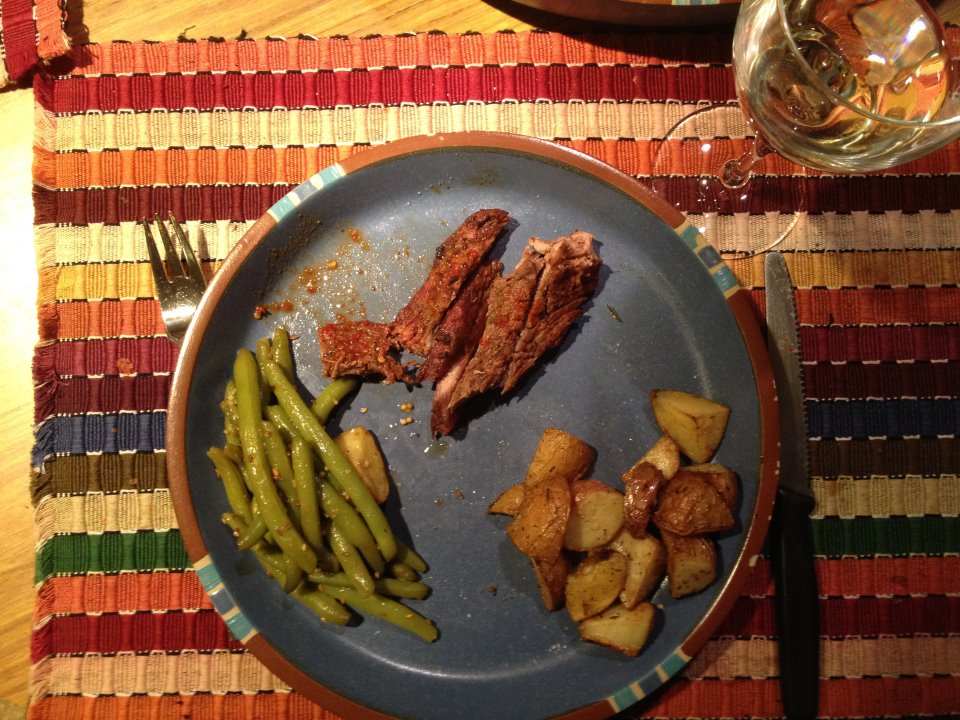
Flank steak with my Dad's homemade hot sause, local green beans with spicy mustered sause, and local new potatoes. Yum. 
OH, one more thing: FOOD.  Dang I love food in the USA.  I have been eating well and often in the US!  I had delicious home cooked meals made by my Dad.  He basically cooked all the foods that I have been really missing (mushrooms, flank steak, mixed greens, potatoes, etc.), and my friends Emily and Micah have been taking me to some of the incredible restaurants that Ann Arbor has to offer…. including South Indian food! Yum!  However in between my various delicious flavorful meals, I have been drinking plenty of tererĆ©.  To my delight my family and Micah and Emily have been joining in as well… just in time for summer in the States.
In a few days I head back to Paraguay where winter has apparently arrived with a vengeance.  Guess Ill be switching from tererĆ© to mate ….

Wednesday, May 16, 2012

Bigots Deserve Access to Development Workers Too


Ƒa Annastasia showing the abonos verde carnavalia intercropped with mandioca (This photo is completely unrelated to this blog post... but I like it anyways).

I looked at my facebook page recently, and I realized just how… well, gay it had become.  Well over half the links I post are about equal rights, and lgbt news stories.  It didn’t used to be that way.  In the States, due to my open-minded community, loving family and accepting college town, being queer was not something I thought about that much.  It simply wasn’t a big deal. I rarely considered if and how being queer influenced my interactions with people, my safety, or my future.  Liking women (and men) was part of who I was, but it wasn’t a big part. Occasionally I might sign a petition or speak up in a conversation if it seemed necessary, but all-in-all I was very casual in my lgbt identity. Because it was rarely something I felt ostracized for, it was never something about which I sought support.  But as a Peace Corps volunteer, I have to be closeted in site in order to productively do the development work I came here to do.  So now, perhaps due to being closeted, if I’m lucky enough to have an internet signal, I find myself trolling Huffington Post Gay news section for hopeful or shocking news stories.  I have started to closely follow equal rights issues in the states (ex: repeal of DADT, North Carolina amendment banning same-sex marriage, President Obama public support for marriage equality). I have become more interested in the advancement of equal rights and acceptance because I now feel the lack of them.  Ironically, having to hide my sexuality has made my sexuality more central to my identity.
One of the absolute most important reasons to be out, is that people begin to revise their bigoted opinions, when they realize they actually personally know someone who is gay.  When it comes to votes, and rights, they realize that their actions will directly affect someone one they know as a person, not just as a sexuality.  One of the questions I struggled with for a while, was why doesn’t this apply in Paraguay?  Shouldn’t I open here for the same reason I’m open in Indiana?
I realized that it doesn’t apply because as an agriculture volunteer, I am here to work with everyone who has degraded soil on their farm.  Bigots deserve access to development workers too.  There are already so many barriers to over come to get someone to try something new on their farm, why add something else?  I’m not Catholic, but I don’t advertise that to the community for the same reason.  In order to work with as many people as I can, I want to present as few barriers as possible.  If I were to come out at the end of my service, or several years from now when I come back for a visit, the community will know me as a person.  They will know the work I did.  They will have to reconcile, the person they know with the sexuality they object to.
By not being out, I am able to reach more people and be more effective.  But it means I am not able to be a resource for the lgbt youth and adults that live in the community.  No one is out, but I have my suspicions about a few folks.  I can’t be a role model for them, because they don’t know what we have in common.  I can’t come out to them, because it could compromise my position in the community (one well-worn strategy for deflecting suspicion off your self is to become an out-spoken homophobic ass (ex: Ted Haggard, George Rekers, etc).  This is the hardest part about not being out in site.
There is gay rights movement in Paraguay.  Things are changing especially amongst the youth and in the larger towns and cities.  But out here in the campo, there is still a long way to go. Poco a poco, I guess.
I am about to head back to the States for a much needed vacation.  I had heard it said that things pick up in the second year, and that is definitely what has happened for me.  I am involved in things at site.  There are things I wish I spent less time doing (English classes), and things I wish I spent more time doing (abonos verdes, gardens).  But I’m just glad to feel kind of busy for once.  Every so often there are mile stones, that I don’t always write about.  For example, an old host brother of mine, shyly ask me for information on STI and condoms.  I was delighted that he trusted me enough to ask for the information, and did my best to bombard him with the information I had (especially sense health isn’t my sector).  Its been 20 months since I came to Paraguay and I have undergone many changes here.  I know my two week vacation is not enough time to really find out, but wonder how those changes will effect my interaction with American culture.

See you soon America.

(Sorry, this is not my best written or focused blog post.  I promise I’m full of ligament excuses.  But I figured I should post it now, and take advantage of the good internet while I could).

Saturday, May 5, 2012

Pets: The Life and Death of Campo Mascotas.

Carrot.  Such a wonderful, faithful little dog.
A month ago, in the midst of a busy week at site, tragedy struck.  My dog, Carrot, died.  And it was my fault.  I went in to Santani on Friday, and Carrot the dog, followed me to the ruta like she always does.   This in and of itself is dangerous and is something I should have trained her out of doing long ago.  But I always rather like the company on the long walk to the ruta, and the usually extended wait for the bus.  But this last time I went to the ruta, I walked down the highway a bit to find a shadier spot to sit and wait.  Carrot accompanied me, brining her in much closer proximity to the racing trucks and motos that she normally gets.  Apparently, moments after the bus arrived and I left for Santani, a truck sailed by instantly killing her.
The family at the ruta where I leave my bike told me of her fate once I returned.  Someone else at the ruta had a car and we brought her back to my house.  Later that day, I picked a nice shady spot under the trees in my front yard with a good view, and buried her.
I still think having a dog was one of the best decisions, in terms of my mental health, that I made here.  Having a dog who would be beside herself with joy when ever I came home, meant that no matter how my day had gone, it always got a little better.  Dogs also help create a structure and a rough schedule to life.  Although out here in the campo, dogs are pretty self sufficient.
Berenjena when she was just a pup.

I had another dog before Carrot, named Berenjena.  But she eventually decided to live at my host family’s house instead of mine.  So now she is their dog.  The only thing that stuck, was the name.  However, even Bejenjena might be on her way out of this world.  She refuses to eat most of the time (she wont eat the carne my host family gives her, or the dog food I try to feed her on the rare occasions she deigns to visit my house).  I gave her drops in case she had stomach worms but it had no effect.  My host father said he looked into Berenjena’s eyes and saw death.  He predicts she will not live for much longer.
If Berenjena dies, I will have lost two dogs and one cat during my time in Paraguay (I had a cat-not pictured- for a short time last year, but it disappeared in August and never returned.  I assume it died).  That is not a very good track record. 
Its not all bad.  I have had a wonderful cat for several months now, named Perejil.  He seems healthy and happy in my house.  However due the fate most of my pets seem to face, I was hesitant to get another dog… But an English speaking Paraguayan friend of mine offered me a little female puppy, and I just couldn’t say no…  I have named her Pepper.  She is very very adorable. Tonight is her first night in my house!
Clearly Perejil enjoys the space heater as much as I do.

My new dog! Se llama Pepper.

Wednesday, April 25, 2012

Fiesta Patronal, Semana Santa and Chipa

Its been a busy few months at site, so I don’t have a proper blog post for you.  This will be a blog post in photo form, with a few clarifying comments for each photo.  The first 6 photos are from the Fiesta Patronal (Patron Saints Day) for my community.  San Jose, March 19th.  The other 8 photos are from Semana Santa (Holy Week).  Thats they week leading up to easter, which in many Latin American countries, is actually more important than Easter Sunday itself.
Fiesta Patronal
I included this photo because of the grain plants on the priest's stole. Super appropriate for such an agricultural society.


The babys of the community got baptized.  Their families are so proud

The women of the community cooking lots of food for everyone.  They were really flattered that I wanted to photograph them while they worked.  Cooking is something they take pride in, but it is not very frequently acknowledged.
So much food!
Na Oheniea and some of her grand children.


Now on to Semana Santa... and CHIPA!
We made the traditional food for Semana Santa: chipa.
Look! My name in chipa!
This is a tatakua.  Basically a brick oven especially for Paraguayan specialties... like chipa.

Baking the chipa.

More chipa...


On the Thursday of Semana Santa (the biggest meal of the week), I ate dinner with my favorit host family.

A modest but delicious spread of bbq chicken, sopa paraguaya (not actually a soup), mandioca (yucca) and soda.  After lunch we snacked on... you guessed it: chipa.